
Braille Signs for Businesses: A Complete Guide to Installation and Specifications
Accessibility is no longer an optional choice for a modern business—it is a basic requirement for serving all customers, including those with visual impairments. Braille signs are one of the simplest yet most effective accessibility tools that a store, hotel, office, or public space can implement.
What Are Braille Signs?
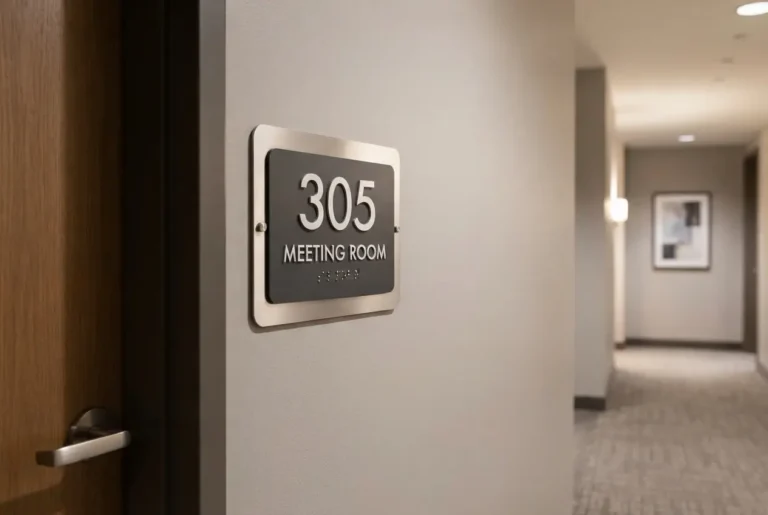
These are signage labels—for indoor or outdoor use—that feature Braille dots in addition to printed or embossed text, so that the information can be read by touch. They are typically used for:
- Room and floor signage in hotels
- Signs for restrooms, emergency exits, and elevators
- Signage for offices and services in public buildings
- Informational signs in museums and exhibition spaces
- Business entrance signs
Why are they important?
A Braille sign isn’t just for people who are completely blind. It’s equally helpful for people with partial vision loss, older adults, and visitors who, for whatever reason, have trouble reading a conventional sign. At the same time, their presence:
- Enhances the company’s image of social responsibility
- Facilitates compliance with hotel classification standards
- Improves the overall customer service experience
Standards that must be met
Creating a Braille sign is not simply a matter of transcribing text into Braille dots. It requires adherence to specific technical rules:
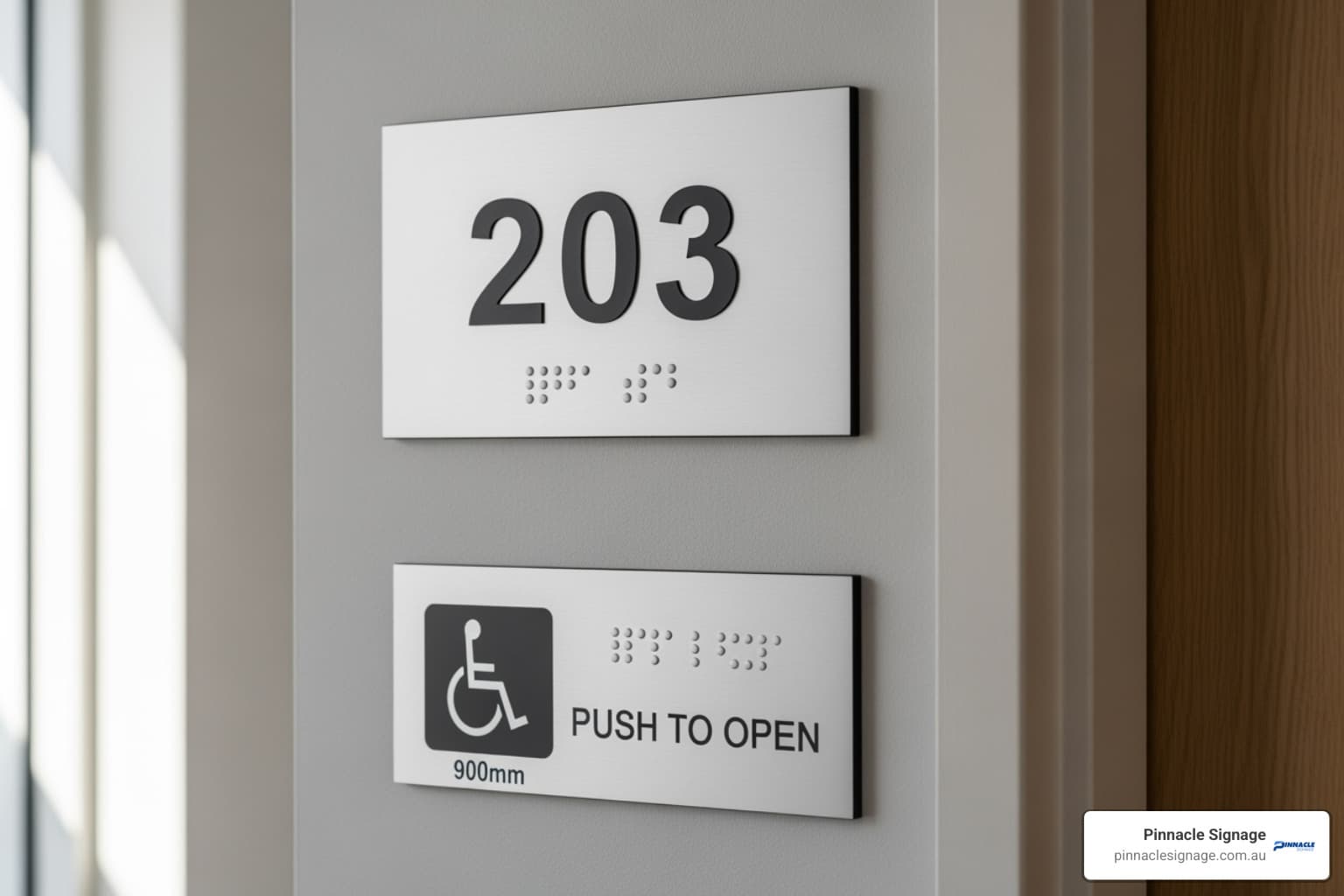
Size and relief of the dots: The dots must be evenly spaced and of uniform height so that they can be easily read with a finger without causing fatigue.
Construction Material: PVC, plexiglass, or metal are typically used—materials that are resistant to wear and tear from frequent contact.
Color Contrast: For people with low vision, the background and text must have a strong visual contrast.
Translation into Braille: The text must be correctly translated into the Greek Braille alphabet, which requires specialized knowledge and is not simply a matter of matching letters.
Installation Height: Signs are usually placed at a height of 120–160 cm from the floor so that they can be reached with a natural arm movement.
Where are they most commonly installed?
- Next to the door, on the vertical side (never on the door itself, since it moves)
- On a stable spot on the wall, with nothing in front of it
- Uniform heights throughout the building, for predictability
How We Handle Construction
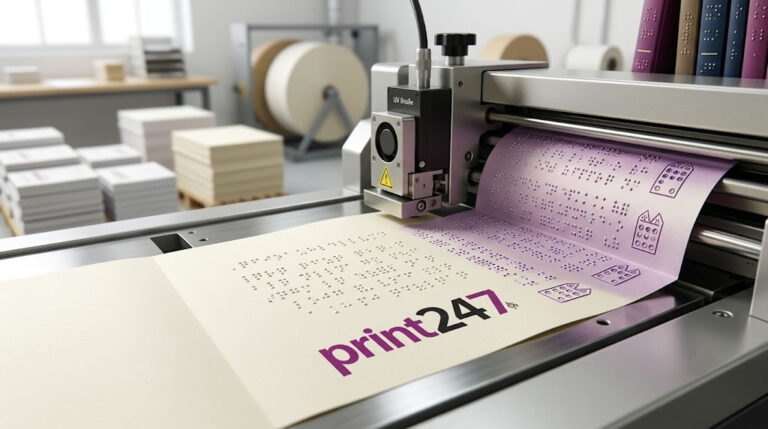
At print247, we design, translate into Braille, and manufacture signs tailored to the needs of any space—from a single room sign to a complete building signage system. With 25 years of experience in specialty printing, we ensure that every sign meets technical specifications and stands the test of time.
If you need Braille signs for your business, hotel, or facility, or contact us for a quote. .